
What to Consider Before Enrolling in a Digital Marketing Course
Choosing a digital marketing course is an important career decision, especially when there are so many institutes, online programs, and training optio

Zeon Academy
Sep 3, 20261m read

Zeon Academy
Digital marketing has become one of the most valuable skills for students, job seekers, entrepreneurs, and professionals. As businesses increasingly depend on websites, search engines, social media, email, and online advertising to reach customers, the demand for digital marketing skills continues to grow.
However, learning digital marketing can feel overwhelming at first. There are many areas to understand, including SEO, social media marketing, content marketing, Google Ads, email marketing, analytics, and more.
Fortunately, you don’t have to become an expert at everything at once. With the right learning path, practical experience, and consistent effort, you can build a strong foundation and gradually develop professional-level skills.
This beginner’s guide explains how to learn digital marketing successfully, what you should learn first, and how to choose the right training program.
Promoting goods, services, companies, or brands online is known as “digital marketing.”
Among the most crucial facets of digital marketing are:
Search Engine Optimization (SEO)
Search Engine Marketing (SEM)
Social media marketing
Content marketing
Email marketing
Google Ads and paid advertising
Website analytics
Affiliate marketing
Influencer marketing
Conversion rate optimization
These areas are connected. For example, SEO can bring organic traffic to a website, while Google Ads can generate paid traffic. Content marketing can support both SEO and social media, while analytics can help you understand which strategies are actually producing results.
For beginners, the goal should not be to learn every tool immediately. Instead, focus on understanding how the different components work together.
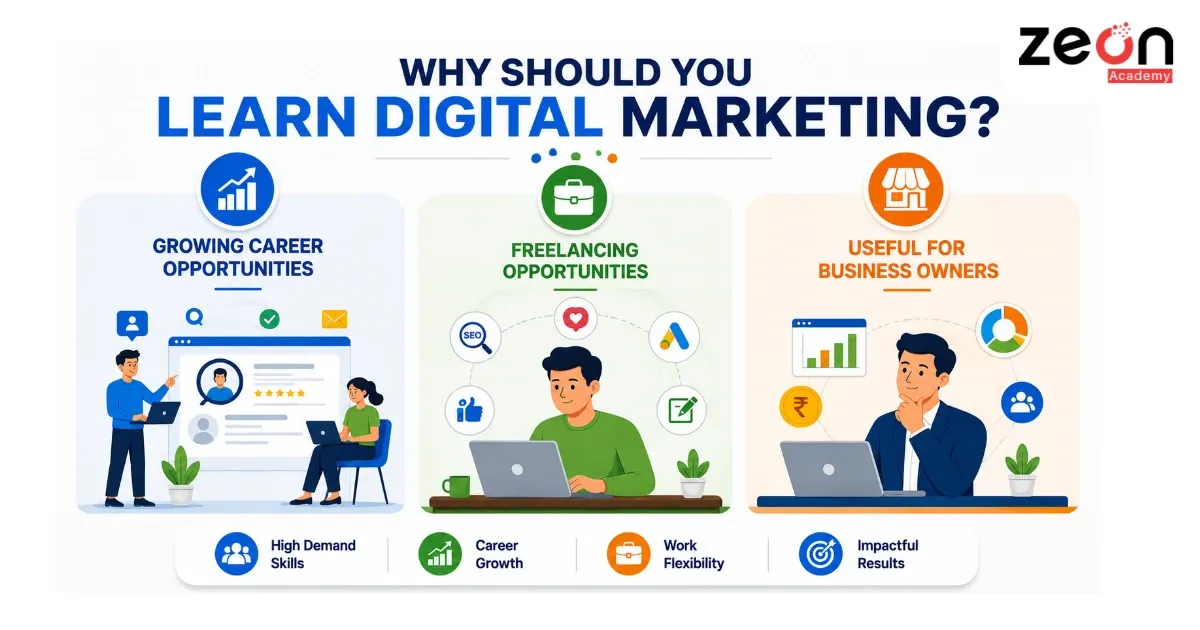
There are several reasons why digital marketing is an attractive career skill.
Businesses of almost every size need people who can help them attract customers online. This creates opportunities for digital marketing executives, SEO specialists, social media managers, paid advertising specialists, content marketers, and digital marketing analysts.
Digital marketing can also be useful for freelancers. You can provide services such as SEO, social media management, content creation, Google Ads management, or website optimization to clients.
However, freelancing is not as easy as simply completing a course. You need practical skills, a portfolio, communication abilities, and the ability to generate measurable results.
Entrepreneurs can benefit from understanding digital marketing even if they eventually hire an agency or marketing team. Basic knowledge helps business owners understand customer acquisition, advertising costs, website performance, and marketing results.
One of the biggest mistakes beginners make is jumping directly into tools without understanding the fundamentals.
Before learning complicated platforms, understand basic concepts such as:
Target audience
Customer journey
Buyer personas
Marketing funnel
Branding
Value proposition
Conversion
Customer acquisition
Return on investment (ROI)
For example, knowing how to create a Google Ads campaign is not enough. You also need to understand who you are targeting, what they are searching for, what offer you are presenting, and what action you want them to take.
Strong fundamentals make the individual tools much easier to understand.
One of the most crucial aspects of digital marketing is search engine optimization.
SEO focuses on improving a website’s visibility in organic search results. It generally includes three major areas:
This involves optimizing elements on your website, such as:
Page titles
Meta descriptions
Headings
Content
Internal links
URLs
Images
Keyword usage
Technical SEO focuses on how search engines access, understand, and index your website.
Important areas include:
Website speed
Mobile usability
Crawlability
Indexing
XML sitemaps
Structured data
HTTPS
Core Web Vitals
Off-page SEO includes activities that help build a website’s authority and reputation, particularly through relevant backlinks and online mentions.
SEO is not about inserting keywords into a page repeatedly. Modern SEO requires useful content, good user experience, technical accessibility, search intent alignment, and credible signals.
Keyword research is another fundamental digital marketing skill.
A term or phrase that users type into a search engine is called a keyword. But not every keyword has the same purpose.
For example:
“What is digital marketing?” — informational intent
“Digital marketing course in Kochi” — commercial intent
“Best digital marketing course in Kochi” — strong commercial intent
“Digital marketing institute in Kochi” — commercial/local intent
Understanding search intent helps you create content that matches what users actually want.
Instead of focusing only on search volume, consider relevance, competition, intent, and business value.
Content is an important part of almost every digital marketing strategy.
Content can include:
Blog posts
Social media posts
Videos
Infographics
Case studies
Landing pages
Email newsletters
E-books
Good content should solve a problem, answer a question, educate the audience, or help them make a decision.
For example, a digital marketing training institute could publish articles about career opportunities, SEO basics, Google Ads, social media marketing, and practical marketing strategies.
The objective should not simply be to publish as much content as possible. Useful, relevant content is more valuable than content created only to target keywords.
Social media platforms allow businesses to communicate directly with their audiences.
As a beginner, learn how to:
Identify the right platforms for a target audience.
Create a social media strategy.
Develop content ideas.
Create content calendars.
Write engaging captions.
Understand basic social media analytics.
Run paid social campaigns.
Measure engagement and conversions.
Do not assume that every business needs to be active on every platform. The right platform depends on the audience, industry, content format, and business objectives.
Another crucial digital marketing competency is paid advertising.
Google Ads allows businesses to reach potential customers when they search for relevant products and services.
Beginners should understand concepts such as:
Campaign structure
Keywords
Match types
Negative keywords
Ad copy
Quality Score
Bidding
Landing pages
Conversion tracking
Cost per click (CPC)
Cost per acquisition (CPA)
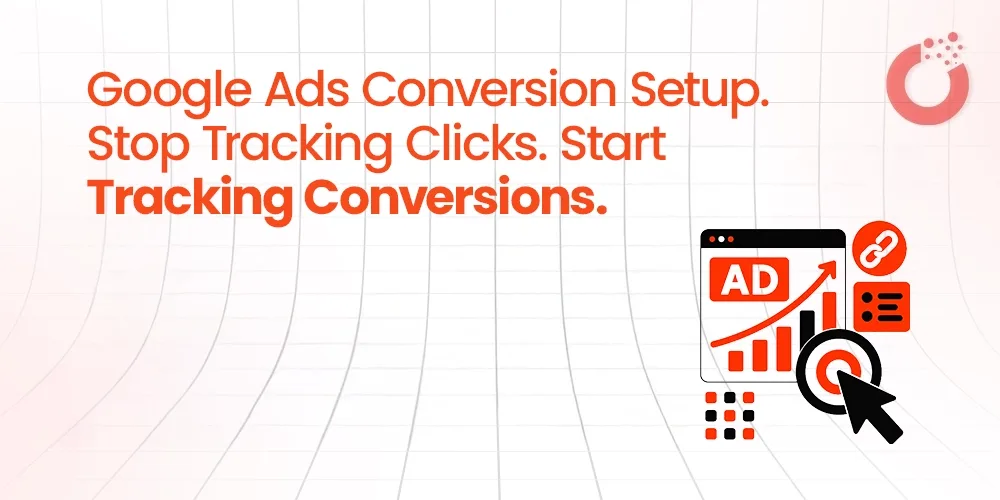
Focusing solely on clicks is a common error made by beginners.
Getting 1,000 clicks does not automatically mean a campaign is successful. The more important question is whether those clicks generate leads, sales, or another valuable conversion.
Digital marketing becomes much more powerful when you can measure performance.
You should become familiar with tools such as Google Analytics and Google Search Console, along with the analytics features available on advertising and social media platforms.
Learn to interpret metrics such as:
Organic traffic
Click-through rate
Conversion rate
Bounce and engagement metrics
Cost per click
Cost per lead
Return on ad spend
Leads and sales
The purpose of analytics is not to collect endless numbers. It is to answer useful questions:
What is working? What is not working? Why? What should we change next?
That mindset is essential for becoming a good digital marketer.
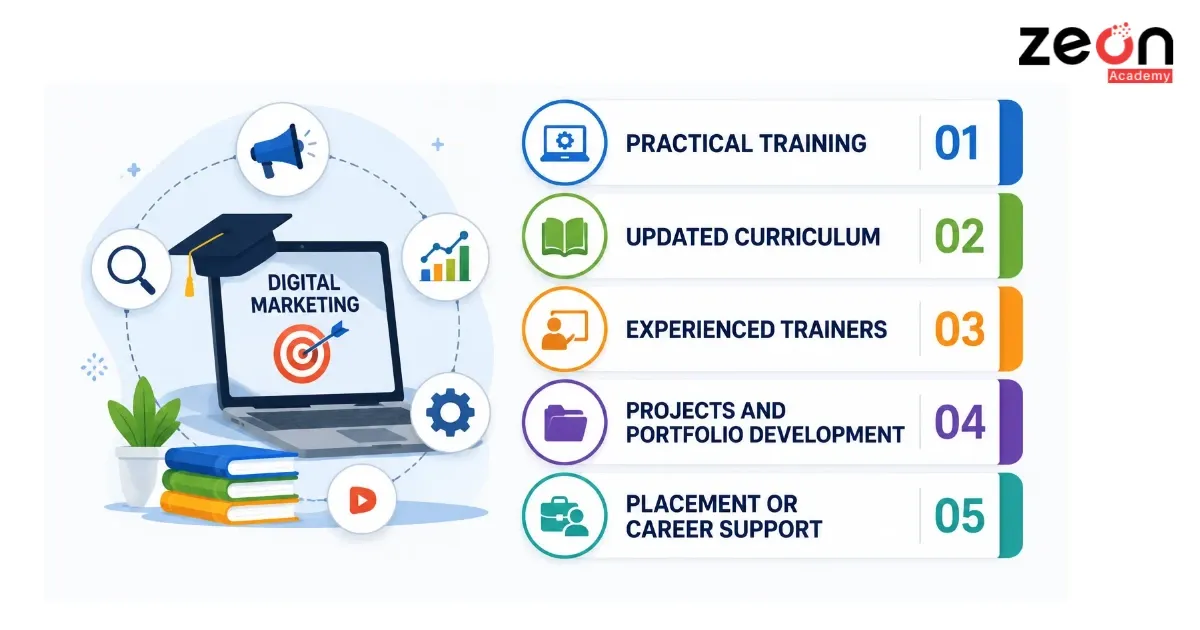
Self-learning is possible, but a structured course can help beginners learn faster and avoid common mistakes.
If you are looking for the best digital marketing course in Kochi, do not choose a course only because it has attractive advertisements or a high number of modules.
Instead, evaluate the course based on practical factors such as:
Digital marketing is a practical skill. A good course should provide opportunities to work on websites, campaigns, content, SEO tasks, analytics, or realistic projects.
Digital marketing changes frequently. Check whether the curriculum covers current SEO practices, advertising platforms, analytics, AI-assisted workflows, and other relevant developments.
A trainer’s practical industry experience can make a major difference. Look for instructors who can explain real campaigns, problems, strategies, and results rather than simply presenting theoretical information.
A certificate alone does not prove that you can do digital marketing.
Projects are much more useful because they give you something concrete to discuss during interviews or with potential clients.
If your objective is to get a job, investigate what career support the institute actually provides. Do not rely solely on claims such as “100% placement.”
Ask about the type of companies hiring students, roles offered, and how the placement process works.
If you are comparing options for the best digital marketing course in Kerala, use the same criteria. Don’t assume that the most expensive course or the most heavily advertised institute is automatically the best choice.
For novices, this is one of the most crucial steps.
Instead of learning only through lectures, create something yourself.
You could:
Start a simple website.
Create a blog.
Perform keyword research.
Optimize pages for SEO.
Create social media content.
Set up analytics.
Run a small advertising campaign.
Analyze website traffic.
Build a content strategy.
These projects help turn theoretical knowledge into practical skills.
They also give you evidence of your abilities when applying for jobs or approaching clients.
A portfolio can be more convincing than a certificate.
Your portfolio could include:
SEO audits
Keyword research reports
Content strategies
Website optimization projects
Social media campaigns
Google Ads campaign analysis
SEO growth reports
Case studies
If you do not have clients yet, create your own projects.
For example, you could build a website around a topic you understand and document your SEO process from keyword research to content creation and performance analysis.
The goal is to demonstrate how you think and what you can actually do.
Digital marketing is a broad field. Trying to master SEO, Google Ads, Meta Ads, social media, email marketing, graphic design, video editing, analytics, web development, and AI simultaneously can slow you down.
Start with a strong foundation.
A practical learning sequence could be:
Digital marketing fundamentals → SEO → Content marketing → Social media → Google Ads → Analytics → Advanced specialization
Once you understand the fundamentals, you can decide which area you want to specialize in.
Learning a skill is different from watching tutorials.
You might understand how an SEO audit works after watching a video, but you develop real skill only when you perform an audit yourself.
Use a simple learning cycle:
Learn → Practice → Analyze → Make mistakes → Improve → Repeat
Even one or two hours of consistent practical work can be more valuable than spending weeks passively watching courses.
Digital marketing does not remain static.
Search algorithms change. Advertising platforms introduce new features. Consumer behavior evolves. AI is changing content creation, research, advertising, analytics, and many other marketing workflows.
As a result, finishing a course shouldn’t be seen as the conclusion of your educational career.
Successful digital marketers continuously test strategies, study data, follow industry changes, and improve their skills.
Learning digital marketing successfully is not about collecting certificates or memorizing definitions. It is about developing the ability to understand audiences, create effective strategies, execute campaigns, analyze results, and improve performance.
Start with the fundamentals, learn the major channels, and then gain practical experience through real projects. If you choose a course, evaluate it based on practical training, curriculum quality, trainer experience, projects, and career support rather than marketing promises alone.
Most importantly, practice while you learn. The faster you move from watching tutorials to actually building campaigns, optimizing websites, creating content, and analyzing data, the faster you will develop genuine digital marketing skills.
1. Digital marketing is what?
Digital marketing is the process of promoting a business, product, or service using online channels such as search engines, social media, websites, email, and digital advertising.
2. Is digital marketing a good career?
Yes, digital marketing is a good career for people interested in marketing, technology, creativity, and data. It offers opportunities in SEO, social media, content marketing, paid advertising, analytics, and freelancing.
3. What is SEO in digital marketing?
SEO, or Search Engine Optimization, is a digital marketing strategy that improves a website’s visibility in organic search results. It helps businesses attract relevant traffic from search engines like Google.
4. What is search engine optimization in digital marketing?
Search Engine Optimization (SEO) is the process of optimizing a website’s content, technical structure, and overall online presence to improve its visibility in search engine results and attract relevant visitors.
5. What is social media marketing?
Social media marketing is the practice of promoting a business, product, or service through platforms like Instagram, Facebook, LinkedIn, and YouTube to build brand awareness, engage audiences, generate leads, and drive sales.
Choosing a digital marketing course is an important career decision, especially when there are so many institutes, online programs, and training optio
Zeon Academy

Digital marketing has become one of the most important career fields in India as businesses continue to move their operations, communication, and cust
Zeon Academy
Digital marketing has become one of the most important parts of modern business. As customers spend more time searching, shopping, communicating, and
Zeon Academy
Digital marketing has become one of the most dynamic career fields in the modern business world. As companies invest more heavily in search engines, s
Zeon Academy
Digital marketing is changing faster than ever. Search engines are becoming smarter, social platforms are relying heavily on algorithms, and customers
Zeon Academy
Digital marketing has become one of the fastest-growing career fields in recent years. Businesses of every size are investing heavily in online advert
Zeon Academy
Digital marketing has become one of the most promising career paths for students, entrepreneurs, freelancers, and working professionals. Businesses of every size rely on digital channels to
Zeon Academy
Digital marketing has become one of the most attractive career choices for students, professionals, entrepreneurs, and career changers. As businesses continue to shift their focus toward onl
Zeon Academy
https://www.zeonacademy.com/course/ Choosing the right digital marketing course can shape your career, whether you're a student, working professional, entrepreneur, or freelancer. With the r
Zeon Academy
Digital marketing is one of the fastest-growing career fields today, offering opportunities across industries such as e-commerce, healthcare, education, real estate, technology, and entertai
Zeon Academy
Digital marketing has changed significantly over the last few years. Businesses no longer run advertisements just to get traffic; they run advertisements to generate measurable results such
Zeon Academy
Imagine you're planning to buy a new smartphone. What's the first thing you do? Most people don't rush to the nearest store anymore. Instead, they open Google, watch YouTube reviews, compare
Zeon Academy