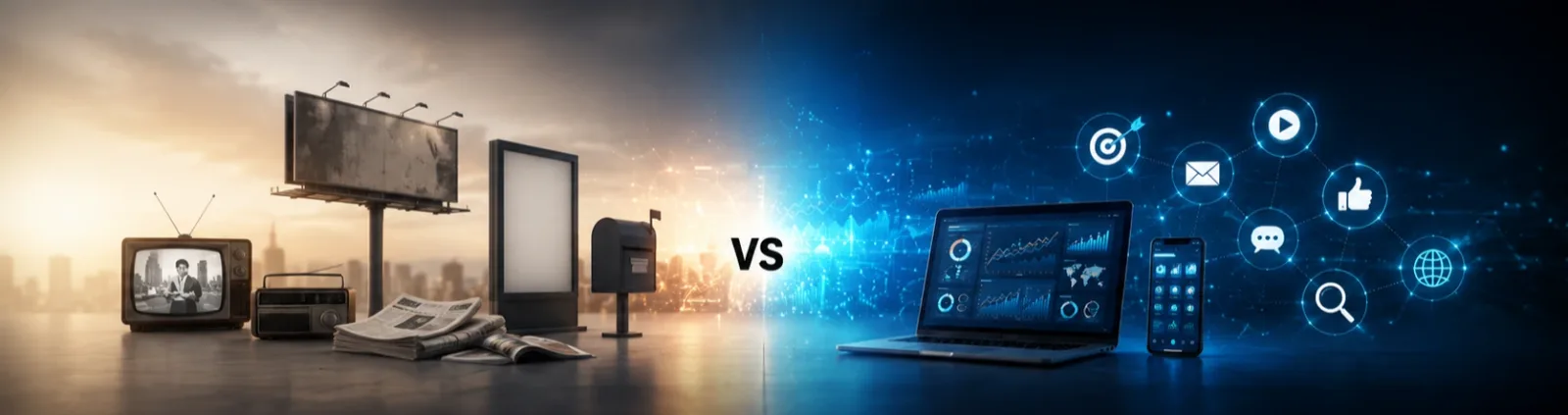
Imagine you're planning to buy a new smartphone. What's the first thing you do? Most people don't rush to the nearest store anymore. Instead, they open Google, watch YouTube reviews, compare prices online, read customer feedback, and maybe even check Instagram or Facebook for recommendations. Now think back 15 or 20 years. The same buying decision was often influenced by a television commercial, a newspaper advertisement, or a billboard on the way to work.
This simple change in consumer behavior perfectly illustrates how marketing has evolved. Businesses no longer rely solely on traditional advertising to reach customers. Instead, they are investing heavily in digital platforms that allow them to connect with the right audience at the right time. That doesn't mean traditional marketing has become obsolete. In fact, many successful brands continue to combine both strategies to maximize their reach and build stronger customer relationships.
Whether you're a business owner trying to decide where to invest your marketing budget or a student planning a career in marketing, understanding the difference between these two approaches is essential. As businesses continue shifting towards online platforms, more aspiring marketers are enrolling in the Best digital marketing course kochi to develop practical skills that match today's industry requirements.
Understanding Traditional Marketing
Before the internet became part of our everyday lives, traditional marketing was the primary way businesses communicated with customers. Brands depended on newspapers, television, radio, magazines, banners, brochures, and outdoor advertisements to promote their products and services. These channels helped companies build trust, establish brand recognition, and reach large audiences long before websites and social media existed.
Even today, traditional marketing continues to play an important role in many industries. A billboard placed on a busy highway attracts thousands of people every day, while a television commercial during a popular cricket match can instantly create nationwide brand awareness. Printed brochures and catalogues also provide customers with something physical they can keep and refer to later.
Some of the most common examples of traditional marketing include:
- Television commercials
- Radio advertisements
- Newspaper and magazine ads
- Billboards and hoardings
- Flyers, brochures, and catalogues
- Event sponsorships and trade exhibitions
Traditional marketing works particularly well for businesses targeting local communities or audiences that spend more time consuming print and broadcast media. Retail stores, hospitals, educational institutions, automobile dealerships, and real estate companies still benefit significantly from offline advertising because it helps strengthen their local presence.
However, traditional marketing also comes with certain limitations. Advertising costs can be quite high, especially for television and print media. Campaigns usually require weeks of planning, and once an advertisement has been printed or broadcast, making changes becomes difficult. Measuring results is another challenge, as businesses often rely on estimates rather than accurate data to determine campaign success.
What is Digital Marketing?
Digital marketing is the process of promoting products or services using internet-based platforms. Instead of reaching customers through newspapers or television, businesses connect with them through websites, search engines, social media platforms, email campaigns, mobile applications, and online advertisements.
The biggest strength of digital marketing is that it allows businesses to interact directly with customers. Instead of simply displaying advertisements, companies can answer questions, respond to comments, share valuable content, and build long-term relationships. Every interaction also generates useful data that helps marketers understand customer behavior and improve future campaigns.
Digital marketing consists of several specialized strategies that work together to increase online visibility and generate business growth.
Some of the most widely used digital marketing channels are:
- Search engine optimization - The process of raising a website's Google and other search engine ranks.
- Social Media Marketing – Promoting brands through Instagram, Facebook, LinkedIn, and other platforms.
- Content Marketing – Creating blogs, videos, infographics, and guides that educate potential customers.
- Email Marketing – Building long-term customer relationships through personalized communication.
- Search Engine Marketing (SEM) – Driving immediate traffic using paid advertisements.
- Influencer Marketing – Collaborating with content creators to reach targeted audiences.
Unlike traditional marketing, digital campaigns can be launched within hours and modified at any time. Businesses can monitor website traffic, advertisement performance, customer engagement, and conversions in real time. This flexibility allows marketers to make quick improvements instead of waiting until a campaign has ended.
Another reason digital marketing has become so popular is affordability. A small startup can compete with established companies by investing in SEO, social media, and valuable content instead of spending huge amounts on television or newspaper advertisements. This has created opportunities for businesses of every size to compete in the same marketplace.
Why Businesses Are Moving Towards Digital Marketing
Over the past ten years, consumer behavior has drastically shifted. Before making a purchase, most customers now conduct online research. They compare products, read reviews, watch demonstration videos, and explore company websites before making a final decision. Businesses that fail to establish a strong online presence risk losing potential customers to competitors who are easier to find online.
Digital marketing also allows businesses to understand exactly how customers interact with their brand. Every website visit, advertisement click, email open, and purchase provides valuable insights that help improve future marketing campaigns. This data-driven approach enables companies to spend their budgets more efficiently while delivering personalized experiences to customers.
For professionals looking to enter this industry, practical skills have become more valuable than ever. Learning how to optimize websites, manage social media campaigns, create engaging content, and analyze marketing performance can open doors to exciting career opportunities. This is why many students choose the Best digital marketing course kochi to gain hands-on experience with industry tools and real-world projects.
Digital Marketing vs Traditional Marketing
Although both strategies aim to increase brand awareness and generate sales, they differ significantly in the way they reach customers and measure success.
Feature
Traditional Marketing
Digital Marketing
Reach
Mostly local or regional
Global audience
Cost
Higher investment
Flexible budgets
Targeting
Broad audience
Highly targeted audience
Results
Difficult to measure
Real-time analytics
Customer Interaction
One-way communication
Two-way engagement
Flexibility
Limited changes
Instant optimization
Digital Marketing vs Traditional Marketing: The Key Differences
At first glance, both traditional and digital marketing appear to have the same objective—promoting a business and attracting customers. However, the way they achieve this goal is completely different.Digital marketing concentrates on reaching the right audience with the right message at the right moment, whereas traditional marketing is based on broadcasting a message to a big audience.
As customer expectations continue to evolve, businesses need marketing strategies that are not only effective but also flexible and measurable. This is where digital marketing has gained a significant advantage over traditional methods. Let's explore the major differences in detail.
1. Audience Reach
Traditional marketing generally reaches a broad audience without distinguishing who is actually interested in the product or service. For example, everyone reading a newspaper or watching a television program sees the same advertisement. While this creates widespread awareness, a large percentage of viewers may never become potential customers.
Digital marketing takes a completely different approach. Businesses can target audiences based on their location, age, interests, profession, browsing history, online behavior, and even previous purchases. This precision ensures that marketing efforts are focused on people who are genuinely interested, resulting in better engagement and higher conversion rates.
For instance, a digital marketing institute in Kochi can run an online campaign that reaches only students and working professionals within Kerala who have shown interest in career development or online learning. This level of targeting simply isn't possible with most traditional advertising channels.
2. Cost and Budget
Budget plays a crucial role in deciding which marketing strategy a business chooses.
Traditional marketing often requires a substantial investment. Producing television commercials, booking newspaper advertisements, printing brochures, or renting billboard space can quickly become expensive. For startups and small businesses, these costs can be difficult to justify.
Digital marketing, on the other hand, is much more budget-friendly. Businesses can start with a small investment, monitor campaign performance, and gradually increase their budget based on the results. Whether you're spending ₹500 a day or ₹5 lakh a month, digital marketing offers the flexibility to scale campaigns according to your business goals.
This affordability has made online marketing accessible to businesses of every size, from local startups to multinational corporations.
One of the biggest limitations of traditional marketing is the lack of accurate performance measurement. A company may invest heavily in a newspaper advertisement or television commercial, but determining exactly how many customers responded to that specific campaign is often difficult.
Digital marketing removes this uncertainty by providing real-time data and detailed analytics. Businesses can track every stage of the customer journey, from the moment someone clicks on an advertisement to the point where they complete a purchase or submit an enquiry.
Some of the valuable insights businesses can measure include:
- Website traffic
- Click-through rates (CTR)
- Customer engagement
- Lead generation
- Conversion rates
- Return on Investment (ROI)
These insights help marketers understand what is working and what needs improvement, making future campaigns more effective.
4. Customer Engagement
Modern customers expect more than advertisements—they expect conversations. They want brands to answer questions, provide useful information, and respond quickly to their concerns.
Traditional marketing mainly supports one-way communication. Businesses share their message, and customers receive it. Interaction usually happens much later when customers visit a store or contact the business directly.
Digital marketing creates opportunities for continuous engagement. Customers can comment on social media posts, participate in live sessions, send direct messages, leave reviews, and share their experiences with others. This two-way communication builds trust and strengthens long-term relationships.
A brand that actively engages with its audience is more likely to earn customer loyalty than one that simply broadcasts advertisements.
5. Campaign Flexibility
Business trends can change overnight. Customer preferences evolve, competitors launch new products, and market conditions shift quickly. Marketing strategies need to adapt just as fast.
Traditional campaigns usually require considerable planning and cannot be changed easily once they are printed or broadcast. Updating a newspaper advertisement or replacing a billboard often involves additional costs and delays.
Digital marketing offers unmatched flexibility. Marketers can edit advertisements, change audience settings, adjust budgets, or even pause campaigns instantly based on performance. This ability to optimize campaigns in real time helps businesses achieve better results while reducing unnecessary spending.
Advantages of Traditional Marketing
Although digital marketing dominates today's business landscape, traditional marketing continues to offer several benefits that make it relevant for many organizations.
Some of its key advantages include:
- Builds strong local brand awareness.
- Creates a physical and memorable presence.
- Reaches audiences who consume newspapers, radio, and television regularly.
- Works well for exhibitions, events, and retail promotions.
- Enhances credibility through established media channels.
For businesses focused on local markets or large-scale branding campaigns, traditional marketing remains a valuable tool.
Advantages of Digital Marketing
The growing popularity of digital marketing isn't accidental. Businesses appreciate its ability to deliver measurable results while offering greater flexibility and lower costs.
Some of its biggest advantages are:
- Highly targeted advertising.
- Real-time performance monitoring.
- Better customer engagement.
- Lower marketing costs.
- Easy campaign optimization.
- Global reach without geographical limitations.
- Higher return on investment.
These benefits explain why businesses across industries are continuously increasing their investment in digital marketing.
Can Traditional and Digital Marketing Work Together?
One common misconception is that businesses must choose either traditional marketing or digital marketing. In reality, many successful companies combine both approaches to maximize their results.
Consider the launch of a new educational institution. The organization may distribute brochures in nearby schools, install billboards across the city, and advertise in local newspapers to build awareness. At the same time, it can run Google Ads, publish informative blogs, create engaging social media content, and optimize its website to attract online enquiries.
This integrated approach ensures that customers encounter the brand across multiple touchpoints, increasing familiarity and improving the chances of conversion.
Businesses today are no longer asking whether traditional or digital marketing is better. Instead, they are focusing on how both strategies can complement each other to create a stronger overall marketing campaign.
Which Marketing Strategy Should You Choose?
By now, it’s clear that both digital marketing and traditional marketing have their own strengths. The real question is not which one is universally better
, but which one aligns with your business goals
. Every business has a different audience, budget, and growth strategy, so the ideal marketing approach will vary from one organization to another.
If your objective is to create strong local awareness, traditional marketing can still deliver excellent results. A well-placed billboard, a newspaper advertisement, or sponsorship of a local event can make your brand familiar to thousands of people within a specific region. Industries such as real estate, healthcare, education, and retail often continue to benefit from these offline marketing methods because they help establish trust within the community.
On the other hand, if your goal is to generate leads, increase website traffic, improve online visibility, or sell products across different cities or countries, digital marketing offers a clear advantage. It allows businesses to target specific audiences, monitor campaign performance in real time, and make improvements whenever necessary. This flexibility makes it a smarter long-term investment for companies that want measurable growth.
For many organizations, the most successful strategy is not choosing one over the other—it is combining both. A company can use traditional marketing to strengthen brand recognition while relying on digital marketing to engage customers, generate enquiries, and convert leads into sales. When these two approaches work together, they create a consistent customer experience across both offline and online channels.
Why a Career in Digital Marketing Is Now Promising
The rapid digital transformation of businesses has created a huge demand for skilled marketing professionals. Today, almost every organization—whether it's a startup, an established corporation, or a local business—needs experts who understand how to build an online presence and attract customers through digital channels.
Unlike many traditional career paths, digital marketing offers opportunities across a wide range of industries. From e-commerce and education to healthcare, finance, tourism, and real estate, businesses are actively recruiting professionals who can manage online campaigns, improve search engine rankings, create engaging content, and analyze marketing performance.
Among the most well-liked job roles are:
- SEO Specialist
- Social Media Manager
- Digital Marketing Executive
- Content Marketing Strategist
- PPC Specialist
- Email Marketing Executive
- Marketing Automation Specialist
- Digital Marketing Manager
- Freelance Digital Marketer
Another reason digital marketing has become such an attractive career choice is its accessibility. You don't necessarily need years of experience or an MBA to enter the field. Employers increasingly value practical skills, certifications, and hands-on project experience. Learning industry tools like Google Analytics, Google Ads, Meta Ads Manager, Canva, WordPress, and SEO platforms can significantly improve employability.
If you're planning to build a career in this field, choosing the Best digital marketing course kochi can provide the practical exposure needed to work on real-world projects, understand modern marketing tools, and gain confidence before entering the industry. A well-structured training program bridges the gap between theory and practical application, making it easier to adapt to the demands of today's digital workplace.
The Future of Marketing
Technology continues to reshape the marketing landscape at an incredible pace. Artificial intelligence, voice search, marketing automation, predictive analytics, and personalized customer experiences are no longer future trends—they are becoming standard business practices. Consumers expect brands to understand their needs, respond quickly, and provide valuable experiences across every platform they use.
At the same time, traditional marketing is unlikely to disappear completely. Television, outdoor advertising, radio, and print media still play an important role in creating brand visibility and reaching specific audience segments. However, their effectiveness increases significantly when they are integrated with digital marketing campaigns.
Businesses that combine offline credibility with online engagement are more likely to build stronger customer relationships and achieve sustainable growth. Instead of viewing digital and traditional marketing as competitors, successful brands now treat them as complementary tools within a unified marketing strategy.
Conclusion
Marketing has evolved significantly, but its purpose remains the same—to connect businesses with the right customers. Traditional marketing laid the foundation for brand building and continues to be valuable for creating local awareness and strengthening brand credibility. Digital marketing, meanwhile, has revolutionized the industry by making campaigns more targeted, measurable, interactive, and cost-effective.
As consumer behavior continues to shift towards online platforms, businesses that embrace digital strategies will be better positioned to compete in today's marketplace. At the same time, combining traditional and digital marketing can create a more balanced and effective marketing strategy, allowing brands to reach customers through multiple touchpoints.
For individuals looking to build a rewarding career, digital marketing offers exciting opportunities across virtually every industry. Developing practical skills in SEO, social media marketing, paid advertising, content creation, and analytics can open doors to corporate roles, freelancing, and entrepreneurship. Enrolling in the Best digital marketing course kochi is a valuable step towards gaining these in-demand skills and preparing for a career in one of the fastest-growing industries in the world.
Frequently Asked Questions
1. What is the main difference between digital marketing and traditional marketing?
While digital marketing promotes companies via websites, search engines, social media, email, and online advertising, traditional marketing uses offline channels like television, newspapers, radio, and billboards.
2. Which is more economical: traditional marketing or digital marketing?
Digital marketing is generally more cost-effective because businesses can start with smaller budgets, target specific audiences, and measure campaign performance accurately.
3. Is traditional marketing still useful today?
Yes. Traditional marketing remains effective for local branding, mass awareness campaigns, and industries where print and broadcast media continue to have strong audience reach.
4. Why is digital marketing growing so rapidly?
The widespread use of smartphones, internet access, and social media has changed the way people research and purchase products. Due to its quantifiable outcomes and improved client interaction, businesses are increasing their investments in digital marketing.
5. Is digital marketing a good career option?
Yes. Digital marketing is one of the fastest-growing career fields, offering opportunities in SEO, content marketing, social media management, paid advertising, analytics, and freelance consulting.