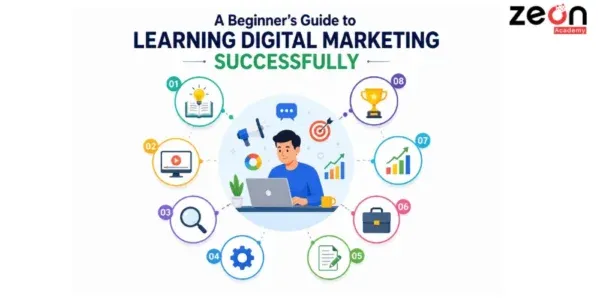
A Beginner’s Guide to Learning Digital Marketing Successfully
Digital marketing has become one of the most valuable skills for students, job seekers, entrepreneurs, and professionals. As businesses increasingly d

Zeon Academy
Sep 2, 20261m read

Zeon Academy
Choosing a digital marketing course is an important career decision, especially when there are so many institutes, online programs, and training options available. A course’s duration, credentials, or promotional offers may appear impressive, but these criteria alone do not indicate whether it will help you develop practical skills.
Before enrolling, look beyond the advertisement. Check the curriculum, trainers, practical exposure, career support, learning format, and overall value for your investment. If you’re looking for the best digital marketing institute in Kerala, here are some crucial aspects to consider before making your pick.
Digital marketing is a broad field. A good course should cover the major topics of web marketing rather than simply one or two technologies.
Look for a curriculum that includes topics like SEO, social media marketing, content marketing, email marketing, analytics, online advertising, and conversion optimization.
The curriculum should also show how digital marketing is applied in enterprises. For example, learning how to make an ad is useful, but understanding how to identify an audience, define campaign objectives, manage a budget, analyze outcomes, and optimize performance is far more beneficial.
Digital marketing changes continuously. Advertising platforms introduce new features, search engines update their systems, and businesses adopt new marketing techniques.
Ask the institute when the curriculum was last updated. You should also ensure that the training uses current industry tools and platforms rather than depending largely on outdated methodologies.
An updated syllabus is especially necessary if you intend to work professionally after completing the course.

One of the most common mistakes students make is selecting a subject based only on classroom theory.
Digital marketing is a practical profession. You need to know how to conduct keyword research, optimize a webpage, create campaigns, analyze reports, prepare content, and make decisions based on data.
Before enrolling, find out whether students get opportunities to work on practical assignments, campaigns, websites, social media accounts, analytics platforms, or realistic marketing projects.
A useful course should allow you to make mistakes, test different approaches, analyze the results, and improve your work. That experience can be far more valuable than simply memorizing definitions for an examination.
The person teaching the subject can significantly influence your learning experience.
Instead of looking only at qualifications, investigate the trainer’s practical industry experience. Someone who has actually managed SEO campaigns, paid advertising, social media accounts, websites, or marketing strategies can often explain concepts using real business situations.
Before you make your pick, consider trainer profiles, professional experience, industry projects, and student reviews.
Don’t hesitate to ask how much interaction students will have with trainers. A course with opportunities for questions, feedback, and project reviews can provide considerably more value than one-way lectures.
Different students learn differently. Some prefer classroom training because they benefit from direct interaction, while others prefer online learning because of flexibility.
Consider your schedule, location, learning style, and availability before choosing between classroom, online, or hybrid training.
A good learning format should make it easy for you to attend sessions consistently, ask questions, complete assignments, and receive feedback. The most expensive or longest course is not necessarily the best choice if the format doesn’t suit your routine.
Certificates can be useful for demonstrating that you completed a course, but a certificate alone will not make you a successful digital marketer.
Employers and clients are generally more interested in what you can actually do. Your ability to analyze a website, develop an SEO strategy, manage an advertising campaign, create useful content, or interpret marketing data can be more important than the certificate itself.
Before enrolling, ask:
What certificate will I receive?
Is there an assessment or practical project?
Will I have work samples to include in my portfolio?
Does the institute provide recognized industry-related certifications or simply its own completion certificate?
The answers can help you understand whether the certification is supported by meaningful training.

If your primary goal is employment, career support should be an important part of your evaluation.
However, be careful with broad claims such as “guaranteed job” or “100% placement.” Ask exactly what the institute means by placement assistance.
A useful career-support program may include resume preparation, interview practice, portfolio development, job alerts, interview opportunities, and guidance on applying for relevant roles.
Also ask whether previous students have moved into roles such as SEO executive, social media executive, PPC specialist, content marketer, or digital marketing executive. Real-world examples might help you understand what to expect.
Testimonials displayed on an institute’s own website can be helpful, but they should not be your only source of information.
Look for independent reviews and discussions where possible. Pay attention to repeated comments about teaching quality, practical training, trainer support, course content, and career assistance.
Don’t focus only on the overall star rating. Read both positive and negative reviews to identify patterns.
For example, if several students independently mention that the practical sessions are useful, that is more meaningful than a single five-star review with no explanation.
Course fees can vary considerably. Instead of simply asking, “Which course is cheaper?” consider what each program offers for the price.
Consider the duration, number of practical sessions, trainer interaction, assignments, projects, learning resources, career support, and additional certifications.
A cheaper course may not necessarily provide better value, while an expensive course isn’t automatically superior.
A portfolio can become an important asset when you’re applying for jobs or approaching clients.
Ask whether the course gives you opportunities to create actual work that you can demonstrate later. This might include an SEO audit, content strategy, social media campaign, Google Ads project, analytics report, or website optimization assignment.
Your portfolio should show your thinking and execution, not just screenshots of course certificates.
If an institute helps you build several meaningful projects during the course, you may finish the program with something tangible to discuss during interviews.
Learning digital marketing can involve plenty of questions. You may struggle with keyword research one day and campaign analytics the next.
Find out what happens when you need help outside regular class hours. Is there mentor support? Can assignments be reviewed? Are doubts answered individually? Do students get comments on their project?
Strong support can make the learning process much smoother, particularly for beginners with no previous marketing experience.
The right course depends partly on what you want to achieve.
If you’re a graduate looking for your first job, you may need a broad foundation and strong practical exposure. If you’re already working in marketing, an advanced course focused on SEO, paid advertising, analytics, or social media may be more appropriate.
Think about your intended career direction before comparing institutes. This prevents you from paying for topics that are irrelevant to your goals.

Before paying the course fee, speak directly with the institute and get clear answers.
Ask about the syllabus, trainers, practical projects, class size, course duration, career support, certification, fees, refund policies, and what resources are included.
You can also ask whether you can attend a demo class. A demo session can help you understand the teaching style and whether the course matches your expectations.
Choosing the best digital marketing course in kerala isn’t about finding the program with the biggest advertisement or the longest list of features.
It is about finding training that matches your goals and gives you opportunities to develop practical, job-relevant skills.
Take time to compare institutes, speak with their representatives, read student experiences, review the curriculum, and understand exactly what you are paying for. A few hours of research before enrollment can help you avoid choosing a course that doesn’t meet your expectations.
A digital marketing course can be a useful starting point for building a career, changing professions, or developing marketing skills for your own business. But the quality of your learning depends heavily on the training program you choose.
Focus on practical exposure, updated course content, experienced trainers, meaningful projects, student support, and realistic career assistance rather than judging a course by its certificate or promotional claims.
The right course should leave you with more than a certificate. It should give you the knowledge, confidence, practical experience, and portfolio needed to take your next step in digital marketing.
Which digital marketing course is best?
The best digital marketing course is one that offers an updated syllabus, practical training, live projects, experienced trainers, and career support. Choose a course that matches your career goals and learning level.
How to learn digital marketing?
You can learn digital marketing through a structured course, online resources, practical projects, and industry certifications. Focus on SEO, social media marketing, Google Ads, content marketing, and analytics.
How to learn digital marketing at home?
You can learn digital marketing at home through online courses, tutorials, blogs, and practical projects. Create a website or social media page to practice SEO, content creation, and online advertising.
How to learn performance marketing?
Learn performance marketing by studying Google Ads, Meta Ads, conversion tracking, analytics, audience targeting, and campaign optimization. Practical campaign experience is especially important.
Digital marketing course how many years?
Most digital marketing courses take a few months to complete rather than several years. The duration depends on the syllabus, practical training, and level of the course.
How can I learn digital marketing?
You can learn digital marketing through an online or classroom course and gain experience by working on practical projects. Start with SEO, social media, paid advertising, content marketing, and analytics.
How do I learn digital marketing?
Start with the fundamentals and gradually develop practical skills in SEO, social media, Google Ads, content marketing, and analytics. A structured digital marketing course can help you learn these skills systematically.
Digital marketing has become one of the most valuable skills for students, job seekers, entrepreneurs, and professionals. As businesses increasingly d
Zeon Academy

Digital marketing has become one of the most important career fields in India as businesses continue to move their operations, communication, and cust
Zeon Academy
Digital marketing has become one of the most important parts of modern business. As customers spend more time searching, shopping, communicating, and
Zeon Academy
Digital marketing has become one of the most dynamic career fields in the modern business world. As companies invest more heavily in search engines, s
Zeon Academy

Digital marketing is changing faster than ever. Search engines are becoming smarter, social platforms are relying heavily on algorithms, and customers
Zeon Academy

Digital marketing has become one of the fastest-growing career fields in recent years. Businesses of every size are investing heavily in online advert
Zeon Academy

Digital marketing has become one of the most promising career paths for students, entrepreneurs, freelancers, and working professionals. Businesses of every size rely on digital channels to
Zeon Academy

Digital marketing has become one of the most attractive career choices for students, professionals, entrepreneurs, and career changers. As businesses continue to shift their focus toward onl
Zeon Academy

https://www.zeonacademy.com/course/ Choosing the right digital marketing course can shape your career, whether you're a student, working professional, entrepreneur, or freelancer. With the r
Zeon Academy

Digital marketing is one of the fastest-growing career fields today, offering opportunities across industries such as e-commerce, healthcare, education, real estate, technology, and entertai
Zeon Academy

Digital marketing has changed significantly over the last few years. Businesses no longer run advertisements just to get traffic; they run advertisements to generate measurable results such
Zeon Academy
Imagine you're planning to buy a new smartphone. What's the first thing you do? Most people don't rush to the nearest store anymore. Instead, they open Google, watch YouTube reviews, compare
Zeon Academy