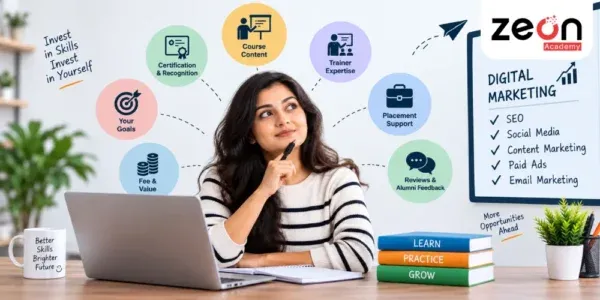
What to Consider Before Enrolling in a Digital Marketing Course
Choosing a digital marketing course is an important career decision, especially when there are so many institutes, online programs, and training optio

Zeon Academy
Sep 3, 20261m read

Zeon Academy
Digital marketing has become one of the most important career fields in India as businesses continue to move their operations, communication, and customer engagement online. From small local businesses to large multinational companies, organizations now depend on digital channels to reach customers, build brand awareness, generate leads, and increase sales. This rapid shift has created a growing demand for professionals who understand search engines, social media, content, advertising, analytics, and other digital platforms.
The future of digital marketing careers in India looks particularly promising because the industry continues to evolve alongside technology and consumer behavior. Companies are not simply looking for people who can publish social media posts or create advertisements. They need professionals who can understand data, develop strategies, work with emerging technologies, and connect digital activities with measurable business results.
For students, graduates, career changers, and working professionals, this creates several opportunities to build a long-term career. However, succeeding in this field requires continuous learning because digital marketing is constantly changing.
India has experienced tremendous growth in internet usage, smartphone adoption, online shopping, digital payments, and social media consumption. As more people spend time online, businesses have had to change the way they communicate with their audiences.
Traditional advertising still has its place, but digital marketing provides businesses with something extremely valuable: measurable interaction with potential customers. A company can understand where visitors come from, which content they engage with, what advertisements generate leads, and which campaigns contribute to conversions.
This has increased the need for professionals who can manage and interpret digital marketing activities. Startups, e-commerce companies, educational institutions, healthcare organizations, tourism businesses, technology companies, and traditional businesses all require digital visibility.
Another important factor is that digital marketing allows businesses of different sizes to compete online. A small company can use search engine optimization, social media, email marketing, and content marketing to reach a targeted audience without depending entirely on expensive traditional advertising.
As more businesses recognize this potential, the demand for skilled digital marketing professionals is likely to remain strong.
The role of a digital marketer is becoming broader than ever. Earlier, many businesses treated digital marketing as a collection of individual activities such as SEO, social media management, or online advertising. Today, these activities increasingly work together as part of a larger customer journey.
A modern digital marketer may need to understand how a customer discovers a brand through Google, interacts with its social media content, visits its website, receives an email, and eventually becomes a customer.
This means future professionals will need both technical and creative abilities. They should be comfortable working with data while also understanding storytelling, communication, branding, and consumer psychology.
Professionals who can connect different digital channels and create integrated strategies may have a significant advantage in the job market.
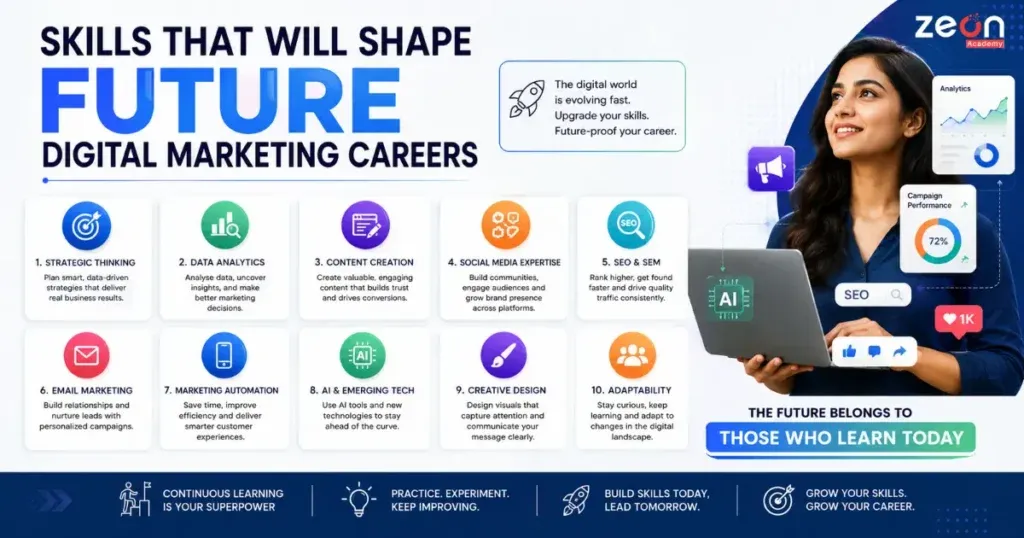
Digital marketing is a diverse field, and professionals can specialize in different areas. However, certain skills are likely to become increasingly valuable as the industry develops.
SEO remains an important digital marketing skill because businesses want their websites to appear when potential customers search for relevant products, services, or information.
Future SEO professionals will need to understand more than keywords and backlinks. Technical SEO, user experience, search intent, structured data, content quality, and changing search experiences will become increasingly important.
Professionals who can combine technical knowledge with high-quality content strategies can help businesses build sustainable organic visibility.
Paid advertising platforms provide businesses with highly targeted ways to reach potential customers. Professionals working in performance marketing need to understand audience targeting, campaign structures, creative testing, conversion tracking, budgets, and return on investment.
The future will favor marketers who can interpret campaign data and make informed decisions rather than simply launch advertisements.
Data has become central to digital marketing. Businesses collect information from websites, advertising platforms, social media channels, customer relationship systems, and other digital touchpoints.
Digital marketers therefore need to understand how to read and interpret data. They should be able to identify trends, measure campaign performance, and use insights to improve future strategies.
Strong analytical thinking can become one of the biggest advantages for professionals entering the field.
Content remains an important part of digital communication. However, simply producing large quantities of content is no longer enough.
Businesses need useful, relevant, original, and audience-focused content. Future content marketers will increasingly combine research, storytelling, SEO, multimedia formats, and audience insights to create meaningful experiences.
Professionals who can adapt content to different platforms and audience segments will have greater opportunities.
Social media continues to influence how people discover brands and interact with businesses. Platforms and trends may change, but the importance of social communication is unlikely to disappear.
Future social media professionals will need to understand platform-specific content, community management, influencer collaborations, paid campaigns, analytics, and short-form video.
Creative thinking will be particularly important because audiences are exposed to enormous amounts of content every day.
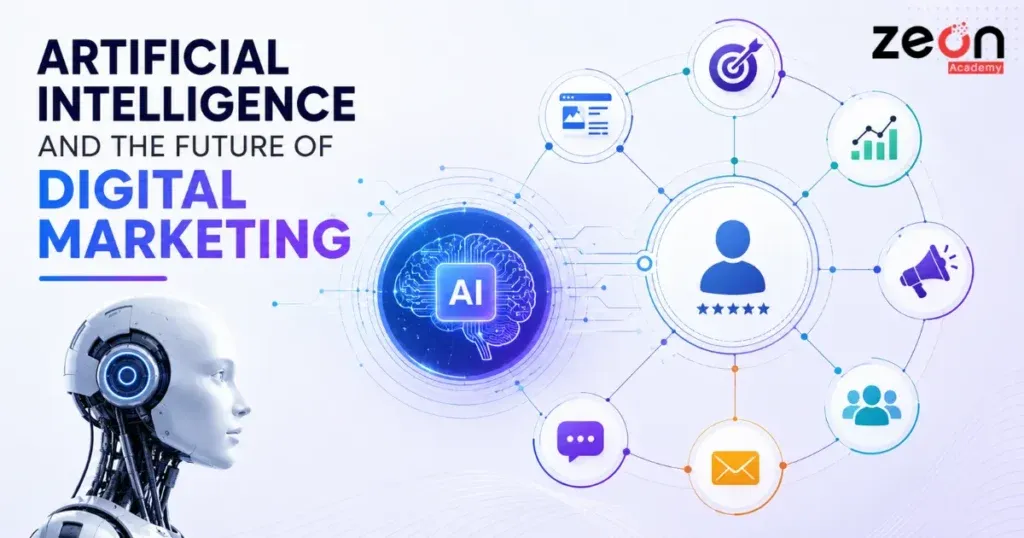
Artificial intelligence is one of the biggest developments influencing digital marketing careers. AI tools can help marketers generate ideas, analyze information, automate repetitive tasks, personalize communication, and improve campaign efficiency.
However, AI is unlikely to eliminate the need for skilled marketers. Instead, it is changing the type of work professionals perform.
For example, AI can assist with generating content ideas, but a marketer still needs to understand the target audience and decide whether those ideas are relevant. Similarly, automated analytics can identify patterns, but human professionals need to determine what those patterns mean for a business strategy.
The future will therefore favor marketers who know how to use AI as a productivity and decision-support tool while maintaining human creativity, judgment, and strategic thinking.
The expansion of digital marketing is creating opportunities across multiple specializations. Professionals do not necessarily have to follow one fixed career path.
Some may begin with general digital marketing and later specialize in SEO, paid advertising, content, social media, email marketing, analytics, or e-commerce.
Other emerging roles may focus on marketing automation, AI-assisted marketing, conversion rate optimization, influencer marketing, customer experience, and marketing analytics.
The availability of remote work has also expanded opportunities for digital professionals. Since many digital marketing activities can be performed online, skilled professionals can work with organizations outside their immediate location.
This flexibility makes digital marketing particularly attractive to individuals who want diverse career possibilities.
Learning digital marketing requires more than memorizing definitions. The industry is practical, and professionals are often expected to work with real platforms, campaigns, websites, analytics tools, and content.
Students should therefore look for learning opportunities that provide practical exposure. Working on sample campaigns, conducting keyword research, analyzing websites, creating content strategies, and understanding advertising dashboards can help learners develop confidence.
For someone beginning their career in this field, choosing the best digital marketing course in kochi can be a useful starting point when the program combines fundamental concepts with practical learning.
The objective should not simply be to complete a course. Learners should focus on developing skills that can be demonstrated through projects, portfolios, certifications, and practical experience.
Certifications can demonstrate that a learner has studied a particular digital marketing platform or concept. They can be useful when building a professional profile, especially for beginners.
However, certifications are only one part of career development. Employers also want evidence that candidates can apply what they have learned.
A portfolio can help demonstrate practical abilities. It may include SEO audits, content plans, social media strategies, sample advertising campaigns, keyword research, website analysis, or analytics reports.
A strong combination of learning, certification, practical projects, and communication skills can make a candidate more competitive.
Digital marketing careers are not limited to traditional employment. Freelancing has become another option for professionals with specialized skills.
Businesses often outsource SEO, content creation, social media management, advertising, website optimization, and other digital services. Experienced freelancers can work with multiple clients across different industries.
Digital marketing knowledge can also help entrepreneurs promote their own businesses. Someone who understands online advertising, SEO, content, analytics, and customer acquisition can build and manage a digital growth strategy without depending entirely on external agencies.
This creates a career environment with multiple paths rather than a single traditional job route.
One of the defining characteristics of digital marketing is change. Search algorithms evolve, advertising platforms introduce new features, social media trends shift, consumer behavior changes, and new technologies emerge.
A plan that works today may require change tomorrow.
For this reason, professionals should develop a habit of continuous learning. Reading industry updates, testing new tools, studying campaign results, attending workshops, and working on personal projects can help marketers remain competitive.
Those who stop learning may eventually find their skills becoming outdated. In contrast, professionals who consistently adapt can create long-term career opportunities.
Students who want to build a career in digital marketing can begin by developing a strong foundation. Understanding SEO, social media marketing, content marketing, paid advertising, email marketing, analytics, and basic website concepts provides a broad starting point.
They should then identify the areas they enjoy most and gradually develop specialization.
A practical career preparation approach can include:
Learn fundamental digital marketing concepts and major tools.
Work on real or simulated projects to build practical experience.
Develop a portfolio that demonstrates measurable skills.
Follow industry developments and continuously update knowledge.
Improve your communication, analytical thinking, creativity, and problem-solving skills.
These skills can remain valuable even as individual platforms and technologies change.
Future employers are likely to place greater emphasis on results rather than job titles alone. A candidate who can explain how they improved organic traffic, generated leads, reduced advertising costs, increased engagement, or improved conversion rates can demonstrate practical value.
Communication will also remain important. Digital marketers frequently work with designers, developers, sales teams, business owners, and content professionals. The ability to explain ideas clearly and collaborate effectively can therefore influence career growth.
Adaptability may be equally important. As automation and AI change marketing workflows, professionals who can learn new technologies and adjust their strategies will be better prepared for the future.
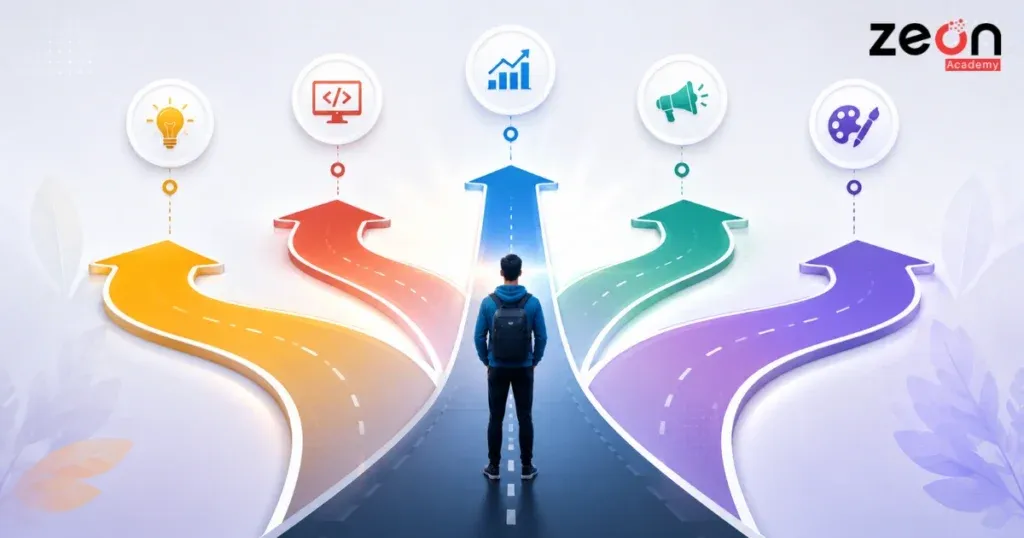
There is no single path to digital marketing. Some people learn through formal courses, while others combine certifications, online resources, internships, and practical projects.
For beginners who prefer structured guidance, a Best digital marketing course kochi can provide a systematic introduction to major areas of the industry. The key is to evaluate the learning experience rather than focusing only on the course title.
Look for practical assignments, experienced trainers, updated curriculum, industry-relevant tools, project opportunities, and career-oriented guidance. A course should help learners understand not only what digital marketing tools do but also why and when marketers use them.
Digital marketing is likely to remain an important part of business growth in India as organizations continue to invest in digital channels. New technologies may change how marketing activities are performed, but the fundamental need to understand customers, communicate value, build relationships, and generate business results will remain.
The professionals who succeed will not necessarily be those who know every tool. Instead, they will be people who understand marketing fundamentals, use technology intelligently, analyze data, communicate effectively, and continuously improve their skills.
For students and professionals considering this career path, the opportunity is significant. With the right combination of education, practical experience, specialization, and continuous learning, digital marketing can offer a flexible and evolving career in India's growing digital economy.
The future of digital marketing careers in India is closely connected to the country's expanding digital economy. Businesses will continue to need professionals who can attract audiences, understand customer behavior, manage campaigns, analyze data, and turn digital interactions into meaningful business outcomes.
Artificial intelligence and automation will change many marketing tasks, but they will also create opportunities for professionals who know how to use these technologies effectively. Creativity, strategic thinking, analytical ability, and adaptability will become increasingly valuable.
For aspiring marketers, starting with quality education and practical exposure can provide a strong foundation. Choosing the best digital marketing course in kochi can be one step toward developing the knowledge and experience needed to enter this dynamic industry. Ultimately, long-term success will depend on the willingness to keep learning, experimenting, and adapting as digital marketing continues to evolve.
1. Is digital marketing a good career in India?
Yes, digital marketing is a promising career in India due to growing online businesses and demand for skilled professionals. It offers opportunities in SEO, social media, content marketing, paid advertising, analytics, and freelancing.
2. Will AI replace digital marketing jobs?
AI is more likely to transform digital marketing jobs than completely replace them. Professionals who understand how to use AI effectively can improve productivity while focusing on strategy and decision-making.
3. Is Digital Marketing course worth it?
Yes, a digital marketing course is worth it if you want to build practical skills in SEO, social media, paid advertising, content marketing, and analytics. It can help you start or advance your career in the growing digital industry.
4. What is digital marketing freelancing?
Digital marketing freelancing means offering services like SEO, social media marketing, content marketing, and online advertising to clients independently, rather than working as a full-time employee.
5. Can I become a digital marketer without a degree
Yes, you can become a digital marketer without a degree. Practical skills in SEO, social media, content marketing, paid advertising, and analytics, along with hands-on experience, can help you build a career in digital marketing.
Choosing a digital marketing course is an important career decision, especially when there are so many institutes, online programs, and training optio
Zeon Academy
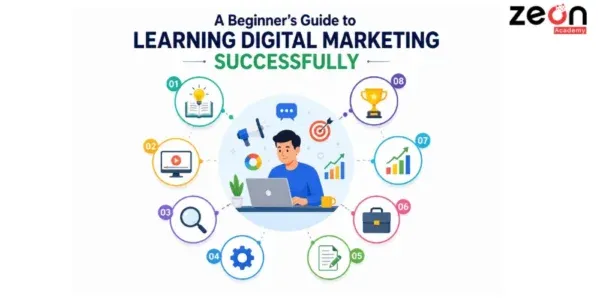
Digital marketing has become one of the most valuable skills for students, job seekers, entrepreneurs, and professionals. As businesses increasingly d
Zeon Academy
Digital marketing has become one of the most important parts of modern business. As customers spend more time searching, shopping, communicating, and
Zeon Academy
Digital marketing has become one of the most dynamic career fields in the modern business world. As companies invest more heavily in search engines, s
Zeon Academy
Digital marketing is changing faster than ever. Search engines are becoming smarter, social platforms are relying heavily on algorithms, and customers
Zeon Academy
Digital marketing has become one of the fastest-growing career fields in recent years. Businesses of every size are investing heavily in online advert
Zeon Academy
Digital marketing has become one of the most promising career paths for students, entrepreneurs, freelancers, and working professionals. Businesses of every size rely on digital channels to
Zeon Academy
Digital marketing has become one of the most attractive career choices for students, professionals, entrepreneurs, and career changers. As businesses continue to shift their focus toward onl
Zeon Academy
https://www.zeonacademy.com/course/ Choosing the right digital marketing course can shape your career, whether you're a student, working professional, entrepreneur, or freelancer. With the r
Zeon Academy
Digital marketing is one of the fastest-growing career fields today, offering opportunities across industries such as e-commerce, healthcare, education, real estate, technology, and entertai
Zeon Academy
Digital marketing has changed significantly over the last few years. Businesses no longer run advertisements just to get traffic; they run advertisements to generate measurable results such
Zeon Academy
Imagine you're planning to buy a new smartphone. What's the first thing you do? Most people don't rush to the nearest store anymore. Instead, they open Google, watch YouTube reviews, compare
Zeon Academy