
What to Consider Before Enrolling in a Digital Marketing Course
Choosing a digital marketing course is an important career decision, especially when there are so many institutes, online programs, and training optio

Zeon Academy
Sep 3, 20261m read

Zeon Academy
Digital marketing has become an essential part of how businesses attract customers, build brand awareness, and generate revenue. From local shops in Kerala to growing e-commerce brands, businesses need professionals who understand how to reach the right audience through search engines, social media, paid advertising, and other digital channels. As this demand grows, learning practical marketing skills can open up opportunities for students, job seekers, entrepreneurs, and working professionals.
However, choosing the right training program requires more than comparing course fees or the number of modules offered. A good program should teach you how digital marketing works in real business situations, how to use industry-relevant tools, and how to measure the results of your campaigns.
If you are searching for the best digital marketing institute in Kochi, understanding the skills you should gain from a training course will help you make a more informed decision. The right learning experience should combine marketing fundamentals, practical assignments, analytical thinking, and opportunities to work on real-world projects.
Let's explore the essential skills you can develop through digital marketing training and how they can help you build a career in this field.

Search engine optimization is one of the most valuable skills covered in digital marketing training. SEO helps websites improve their visibility in organic search results, making it easier for potential customers to discover relevant products, services, and information.
For example, a business offering professional services in Kochi may want its website to appear when someone searches for those services locally. SEO helps businesses improve their chances of appearing for relevant searches by making their websites useful, accessible, and relevant to users.
A comprehensive SEO module should cover three major areas.
On-page SEO: You will learn how to optimize page titles, meta descriptions, headings, URLs, internal links, images, and content structure. You will also understand search intent and how to create content that answers users' questions.
Technical SEO: This involves understanding website crawling, indexing, XML sitemaps, robots.txt, canonical tags, mobile usability, page performance, and structured data. You will learn how technical issues can affect a website's visibility.
Off-page SEO: You will explore how backlinks, brand mentions, digital PR, and other external signals contribute to website authority. Ethical link-building practices are important because low-quality, manipulative links can create problems rather than sustainable growth.
You should also learn keyword research, competitor analysis, local SEO, and performance monitoring through tools such as Google Search Console.
These skills help you understand why a page ranks, identify opportunities for improvement, and build an SEO strategy around business goals rather than simply inserting keywords into articles.
Content marketing focuses on attracting and educating a target audience through useful, relevant information. It supports SEO, builds trust, and helps potential customers understand a business's products or services.
Digital marketing training should teach you how to plan, create, optimize, and distribute content based on audience needs.
You will learn how to identify content topics, analyze search intent, organize articles with logical headings, and write compelling introductions and conclusions. You may also explore content calendars, topic clusters, pillar pages, and internal linking strategies.
For example, a digital marketing academy in Kerala could publish articles about career opportunities, SEO fundamentals, social media marketing, and course selection. These topics can answer prospective students' questions while helping search engines understand the website's subject coverage.
Another important skill is writing content that serves readers instead of focusing exclusively on rankings. A well-optimized article should provide accurate information, clear explanations, relevant examples, and a useful next step.
You should also learn how to use AI writing tools responsibly. AI can assist with research organization, outlining, and editing, but factual verification, originality, subject expertise, and editorial judgment remain essential.
Social media platforms give businesses opportunities to connect with audiences, communicate their brand values, and encourage customer engagement.
A digital marketing course should teach you how to use platforms such as Instagram, Facebook, LinkedIn, and YouTube according to different marketing objectives. Each platform has its own audience expectations, content formats, and engagement patterns.
Essential social media skills
You will learn how to develop a social media strategy, identify target audiences, create content calendars, write engaging captions, and choose suitable formats for different messages.
You may also work with short-form videos, reels, carousels, stories, and professional posts. These formats require different approaches to storytelling, presentation, and calls to action.
Community management is another important area. Responding to comments, handling customer questions, maintaining a consistent brand voice, and identifying recurring audience concerns all contribute to a stronger social media presence.
Beyond publishing content, you should learn to evaluate reach, engagement, clicks, audience growth, and conversions. High engagement does not automatically translate into sales, so effective marketers connect social media activities to broader business objectives.
These skills are useful for social media executives, content creators, freelancers, and business owners who want to manage their online presence more strategically.
Organic marketing takes time to produce results, while paid advertising can help businesses reach selected audiences more quickly. However, successful campaigns require planning, accurate targeting, and continuous optimization.
Google Ads training introduces you to paid search campaigns, keyword targeting, bidding strategies, ad copy, conversion tracking, and campaign performance analysis.
You will learn how to identify relevant commercial keywords, organize campaigns and ad groups, write persuasive advertisements, and create landing pages that match users' expectations.
For instance, a training institute may run search ads for people actively looking for digital marketing education in Kochi. The campaign's success depends not only on attracting clicks but also on generating relevant enquiries from prospective students.
A good training program should also explain advertising budgets, cost per click (CPC), conversion rates, and cost per acquisition (CPA).
You should understand how to evaluate search terms, identify wasted spending, test alternative advertisements, and improve campaign performance using evidence rather than assumptions.
These skills can prepare you for entry-level paid media roles and help you manage advertising campaigns for clients or your own business.
Organic social media marketing and paid social advertising serve related but different purposes. While organic content builds relationships over time, paid campaigns allow marketers to distribute selected messages to defined audiences.
Training may introduce you to Meta Ads Manager, which supports advertising across Facebook and Instagram. You will learn how campaign objectives, audience selection, creative formats, placements, and budgets influence performance.
You should also understand the difference between awareness, traffic, lead generation, and sales campaigns. Choosing the wrong objective can result in activity that looks impressive but does not contribute meaningfully to business growth.
Another important topic is retargeting. This involves reaching eligible audiences who have previously interacted with a business, subject to platform rules and applicable privacy requirements.
Practical exercises should help you compare ad creatives, assess audience responses, and identify which campaigns generate qualified leads.
The goal is not simply to learn how to launch advertisements. It is to understand how to allocate budgets responsibly and improve results through structured testing.
Digital marketing decisions should be based on evidence. Analytics helps you understand what visitors do after reaching a website, where traffic comes from, and which marketing activities contribute to business outcomes.
During training, you should learn the fundamentals of Google Analytics 4 (GA4), Google Search Console, campaign tracking, and performance reporting.
You will explore metrics such as sessions, engagement rate, traffic sources, key events, conversions, and landing-page performance. You should also learn how to interpret these measurements in context.
For example, a website might receive thousands of visits but generate very few enquiries. An analytics review could reveal that visitors are landing on irrelevant pages, struggling to find contact information, or leaving before completing a form.
Understanding this difference helps marketers move beyond reporting traffic numbers to identifying actionable improvements.
You should also become familiar with UTM parameters, which help distinguish traffic generated by specific campaigns, advertisements, emails, or social posts.
The most valuable analytical skill is asking the right questions. Rather than collecting numbers without a purpose, you should learn to connect campaign performance with objectives such as qualified leads, sales, and customer acquisition costs.
Email marketing remains a useful channel for maintaining relationships with prospects and existing customers. It allows businesses to share relevant information, deliver offers, and guide interested people toward a purchase.
Digital marketing training may cover email campaign planning, subscriber segmentation, subject-line writing, automation workflows, and performance measurement.
You will learn why different audience groups need different messages. A prospective student who has requested course details, for example, may need information about the syllabus and learning format rather than a generic promotional email.
Lead nurturing is closely connected to email marketing. It involves providing useful information over time to help potential customers make informed decisions.
Training should also address permission-based marketing, unsubscribe options, and responsible handling of subscriber information.
You may practise creating welcome emails, follow-up sequences, newsletters, and promotional campaigns. The objective is to develop communication skills that support conversions without overwhelming recipients with irrelevant messages.
Attracting website visitors is only part of digital marketing. Businesses must also make it easy for visitors to take meaningful actions, whether that means submitting an enquiry, booking a consultation, downloading a resource, or completing a purchase.
Conversion rate optimization (CRO) focuses on identifying and reducing the barriers that prevent visitors from completing these actions.
You will learn how landing-page headlines, page layouts, calls to action, forms, trust signals, and mobile usability can influence user behaviour.
For example, a course landing page might receive substantial traffic but generate few enquiries because its course information is unclear or its registration form asks for unnecessary details.
A marketer can investigate these problems, form a hypothesis, and test improvements. A/B testing allows two or more versions of an element to be compared when sufficient data and an appropriate testing method are available.
You should also understand that design changes do not guarantee better results. Decisions need to be supported by user feedback, analytics, and reliable testing wherever possible.
CRO is particularly valuable because it helps businesses get more value from their existing traffic instead of relying entirely on increased advertising spend.
Artificial intelligence is changing how marketers research topics, organize information, produce initial content drafts, analyze data, and automate repetitive tasks.
Relevant AI applications should be introduced in a contemporary digital marketing course along with an explanation of their limits. AI tools can improve efficiency, but they do not replace marketing strategy, critical thinking, or subject knowledge.
You may learn to use AI assistants for content ideation, campaign brainstorming, audience research, and drafting. You should also understand how to verify claims, protect confidential information, and review outputs for accuracy and originality.
Marketing automation provides another practical advantage. Automated workflows can help businesses send follow-up messages, categorize leads, manage customer relationships, and trigger communications based on user actions.
The key skill is selecting tasks that benefit from automation without sacrificing relevance or customer experience.
As marketing platforms evolve, the ability to learn new tools and adapt existing workflows will remain important. Focus on understanding the underlying marketing principles rather than memorizing the features of a single application.
Local SEO is particularly relevant to businesses that serve customers in specific geographic areas. Restaurants, clinics, educational institutions, service providers, and retail stores often depend on being discovered by people searching nearby.
If you plan to work with Kerala-based businesses, local marketing knowledge can help you develop more relevant campaigns.
You should learn how Google Business Profile optimization, accurate business information, customer reviews, locally relevant website content, and location-specific landing pages contribute to local visibility.
For example, a business targeting customers in Kochi may need content that addresses local service needs while maintaining useful information for visitors across Kerala.
Local SEO also requires consistency. Business names, addresses, phone numbers, operating details, and service descriptions should be accurate wherever they appear.
Beyond local search, digital marketing strategy brings different channels together. You should understand how SEO, content marketing, paid advertising, email, and social media can support the same business objective.
This broader perspective helps you move from completing individual marketing tasks to planning campaigns that work together.

Learning individual skills is important, but the quality of your training also influences how effectively you can apply them.
When comparing a digital marketing course in Cochin, look beyond promotional claims and examine the learning experience. A useful program should explain core concepts, provide opportunities for practical work, and help students understand how marketing decisions affect business results.
Consider whether the curriculum covers SEO, content creation, social media, paid advertising, analytics, and conversion optimization. Ask how assignments are evaluated and whether learners receive feedback on their work.
Practical exposure matters because knowing what a tool does is different from knowing how to use it to solve a marketing problem. Working on website audits, keyword research, campaign plans, content calendars, and performance reports can help you develop a portfolio of relevant work.
You should also check the trainers' professional backgrounds, the course delivery format, the availability of learning support, and whether the syllabus is updated as platforms change.
At Zeon Academy, prospective learners can explore the available digital marketing training options through the official website and assess whether the curriculum aligns with their career goals.
Choosing a training provider should be a considered decision based on the quality of instruction, practical learning opportunities, and relevance to your intended career path.
Completing lessons is only the beginning. To become more confident in digital marketing, you need to apply what you learn to realistic tasks.
A practical learning project could involve selecting a small business, researching its audience, auditing its website, identifying keyword opportunities, and developing a content plan.
You could then create social media posts, prepare a sample Google Ads campaign, design a landing-page outline, and develop a simple performance report using sample or authorized data.
Document your process and explain why you made each decision. A portfolio that demonstrates your thinking is more useful to potential employers or clients than a list of tools you have studied.
If you are pursuing a digital marketing course in Kochi, look for opportunities to understand the needs of businesses operating in Kerala. Local projects can help you explore regional competition, customer behaviour, language preferences, and location-specific search demand.
Never assume that a campaign succeeds simply because it has been launched. Evaluate its results, identify limitations, and explain what you would improve next.
This habit of testing, measuring, and refining is central to professional digital marketing.
Most comprehensive programs cover SEO, content marketing, social media management, paid advertising, website analytics, email marketing, and conversion optimization. Some also introduce AI tools, automation, and local SEO.
The exact syllabus varies by institute, so review the curriculum before enrolling.
Digital marketing can be a suitable career path for beginners who enjoy communication, research, technology, and problem-solving. You do not necessarily need a technical degree, but you should be prepared to practise regularly and keep learning as platforms evolve.
Compare the curriculum, trainer experience, practical assignments, feedback process, learning support, and overall fees. Ask whether you will work on projects and build a portfolio. Choose a program that matches your goals rather than relying solely on advertising claims.
Yes. Most entry-level digital marketing activities do not require advanced coding skills. However, basic knowledge of HTML, website structure, tracking concepts, and technical SEO can be helpful as you progress.
Useful projects include keyword research, an SEO audit, a content calendar, a social media strategy, a sample paid advertising campaign, an email sequence, and a website performance report. These demonstrate your ability to apply marketing concepts.
Freelancers can use digital marketing skills to offer services such as SEO, content writing, social media management, paid advertising, and analytics reporting. Building a portfolio, defining a clear service offering, and demonstrating measurable value can help attract clients.
Digital marketing training can help you develop a versatile set of skills, from improving organic search visibility and creating useful content to managing advertising campaigns and interpreting performance data. However, completing a course alone does not guarantee employment, clients, or business growth. Your ability to apply these skills, solve real problems, and demonstrate your work makes the difference.
If you are looking for the best digital marketing institute in Kochi, prioritize a program that balances foundational knowledge with practical assignments, meaningful feedback, and exposure to relevant tools. Review the curriculum carefully, ask about project opportunities, and identify the skills most relevant to your goals.
Explore the digital marketing training options available at Zeon Academy through its official website, and compare the curriculum with the practical skills you want to develop. A thoughtful choice today can help you build a stronger foundation for your next step in digital marketing.
Choosing a digital marketing course is an important career decision, especially when there are so many institutes, online programs, and training optio
Zeon Academy
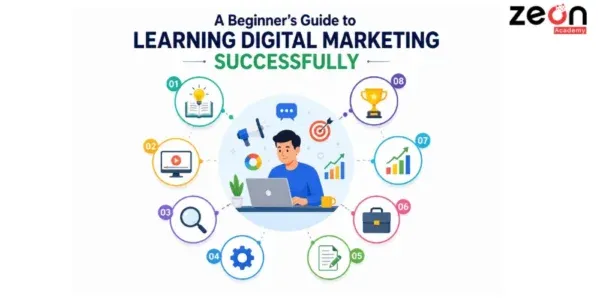
Digital marketing has become one of the most valuable skills for students, job seekers, entrepreneurs, and professionals. As businesses increasingly d
Zeon Academy

Digital marketing has become one of the most important career fields in India as businesses continue to move their operations, communication, and cust
Zeon Academy

Digital marketing has become one of the most important parts of modern business. As customers spend more time searching, shopping, communicating, and
Zeon Academy

Digital marketing has become one of the most dynamic career fields in the modern business world. As companies invest more heavily in search engines, s
Zeon Academy

Digital marketing is changing faster than ever. Search engines are becoming smarter, social platforms are relying heavily on algorithms, and customers
Zeon Academy

Digital marketing has become one of the fastest-growing career fields in recent years. Businesses of every size are investing heavily in online advert
Zeon Academy

Digital marketing has become one of the most promising career paths for students, entrepreneurs, freelancers, and working professionals. Businesses of every size rely on digital channels to
Zeon Academy

Digital marketing has become one of the most attractive career choices for students, professionals, entrepreneurs, and career changers. As businesses continue to shift their focus toward onl
Zeon Academy

https://www.zeonacademy.com/course/ Choosing the right digital marketing course can shape your career, whether you're a student, working professional, entrepreneur, or freelancer. With the r
Zeon Academy

Digital marketing is one of the fastest-growing career fields today, offering opportunities across industries such as e-commerce, healthcare, education, real estate, technology, and entertai
Zeon Academy

Digital marketing has changed significantly over the last few years. Businesses no longer run advertisements just to get traffic; they run advertisements to generate measurable results such
Zeon Academy