
What to Consider Before Enrolling in a Digital Marketing Course
Choosing a digital marketing course is an important career decision, especially when there are so many institutes, online programs, and training optio

Zeon Academy
Sep 3, 20261m read


Zeon Academy
When it comes to organizing a website, using subdomains can be a strategic choice. However, the influence of subdomains on search engine optimization (SEO) often brings up a lot of discussions among established digital marketers. Let’s see how subdomains work, their pros and cons for SEO, and best practices to make sure they don’t negatively affect your site’s visibility.
A subdomain is an extension of your main domain name that functions as a separate section of your website. For example, in blog.website.com, "blog" is the subdomain. Subdomains are commonly used to host content like blogs, forums, or e-commerce stores while maintaining a clear separation from the main site. Subdomains help to create a unique space for specific purposes without cluttering the primary domain. This separation can be perfect if you are looking at targeting specific audiences or trying out new features without impacting the main site.

Search engines look at subdomains as different entities from the main domain. This distinction can influence SEO in the following ways:
Separate Ranking: Subdomains have their own ranking potential. This means they can rank independently for keywords but may not directly contribute to the authority of the main domain.
Crawling and Indexing: Search engines like Google crawl subdomains separately. Without proper internal linking and sitemap submission, subdomains may face challenges in indexing.
Content Focus: Subdomains are best for hosting content that are significantly different from the main domain’s purpose, allowing for customised SEO strategies.

Content Segmentation: Subdomains help in organizing and separating specific types of content, making navigation more intuitive for users.
Targeting Specific Audiences: Subdomains can focus on specific niches or geographic locations, helping with building personalized user experiences.
Easier Collaboration: Teams working on different subdomains can operate independently without affecting the main site’s structure.
Localization: Subdomains are often used for regional or language-specific content, such as de.example.com for German users, bettering user relevance and engagement.

Diluted Authority: Backlinks to a subdomain typically don’t strengthen the main domain’s authority, which can impact overall SEO performance.
Additional Maintenance: Each subdomain requires separate SEO efforts, including link building, content optimization, and monitoring.
Potential Confusion: Poorly structured subdomains can confuse both users and search engines, leading to indexing issues or poor user experience.
Keyword Cannibalization: If not managed carefully, subdomains can compete with the main domain for similar keywords, diluting search engine rankings.
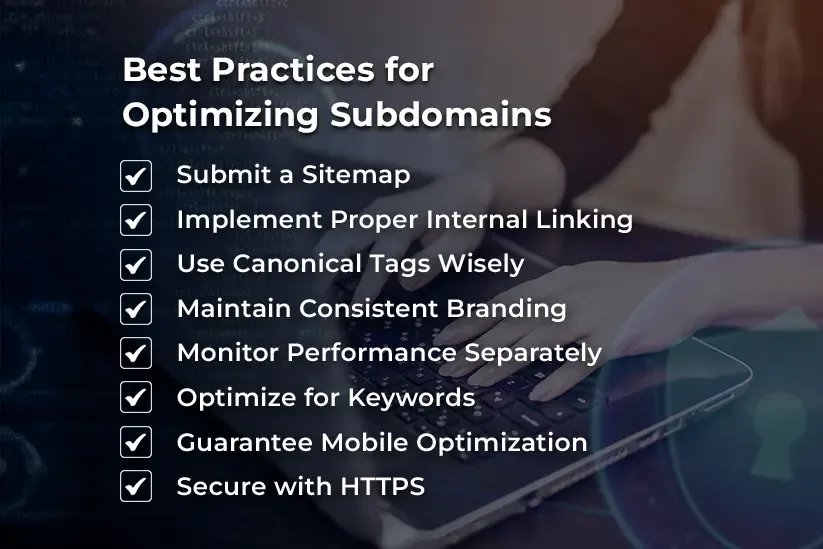
Submit a Sitemap Make sure each subdomain has its own XML sitemap submitted to Google Search Console. This helps search engines crawl and index your content effectively.
Implement Proper Internal Linking Link your subdomain with the main domain and other subdomains to distribute authority and improve navigation.
Use Canonical Tags Wisely Avoid duplicate content issues by setting canonical tags that point to the preferred version of a page.
Maintain Consistent Branding Keep branding elements consistent across your subdomains to reinforce trust and recognition among users.
Monitor Performance Separately Use tools like Google Analytics to track the performance of each subdomain individually. Evaluate traffic, bounce rates, and keyword rankings to identify areas of improvement.
Optimize for Keywords Develop unique keyword strategies for each subdomain to avoid cannibalization and improve relevance for target audiences.
Guarantee Mobile Optimization Make sure each subdomain is mobile-friendly, as mobile-first indexing by Google prioritizes responsive designs.
Secure with HTTPS Install SSL certificates on all subdomains to make sure of secure and encrypted connections. This step is very important for user trust and SEO.

The choice between subdomains and subfolders depends on your specific goals:
Subdomains are suitable for distinctly different content types, such as shop.example.com for e-commerce and support.example.com for customer service.
Subfolders (e.g., example.com/blog) are better when content is closely related to the main site, as they consolidate SEO authority under one domain.

Choosing a digital marketing course is an important career decision, especially when there are so many institutes, online programs, and training optio
Zeon Academy

Digital marketing has become one of the most valuable skills for students, job seekers, entrepreneurs, and professionals. As businesses increasingly d
Zeon Academy

Digital marketing has become one of the most important career fields in India as businesses continue to move their operations, communication, and cust
Zeon Academy

Digital marketing has become one of the most important parts of modern business. As customers spend more time searching, shopping, communicating, and
Zeon Academy

Digital marketing has become one of the most dynamic career fields in the modern business world. As companies invest more heavily in search engines, s
Zeon Academy

Digital marketing is changing faster than ever. Search engines are becoming smarter, social platforms are relying heavily on algorithms, and customers
Zeon Academy

Digital marketing has become one of the fastest-growing career fields in recent years. Businesses of every size are investing heavily in online advert
Zeon Academy

Digital marketing has become one of the most promising career paths for students, entrepreneurs, freelancers, and working professionals. Businesses of every size rely on digital channels to
Zeon Academy

Digital marketing has become one of the most attractive career choices for students, professionals, entrepreneurs, and career changers. As businesses continue to shift their focus toward onl
Zeon Academy

https://www.zeonacademy.com/course/ Choosing the right digital marketing course can shape your career, whether you're a student, working professional, entrepreneur, or freelancer. With the r
Zeon Academy

Digital marketing is one of the fastest-growing career fields today, offering opportunities across industries such as e-commerce, healthcare, education, real estate, technology, and entertai
Zeon Academy

Digital marketing has changed significantly over the last few years. Businesses no longer run advertisements just to get traffic; they run advertisements to generate measurable results such
Zeon Academy